You’ve tossed. You’ve turned. You’ve watched the clock tick from 11:37 PM to 1:15 AM to 3:02 AM. Your mind is a whirlwind of tomorrow’s to-do list, a replay of today’s awkward conversation, and the growing, panicked certainty that you are going to be a zombie in just a few hours. You’ve tried counting sheep, deep breathing, and even that “calming” meditation app, but nothing seems to shut off the buzzing in your brain.
What if there was a method, tested not in a sterile sleep lab but in the demanding, high-stakes environment of military training, that could reliably guide you into sleep’s embrace in just two minutes? What if this technique was so effective it was once a classified secret, designed to ensure pilots could snatch crucial rest between missions, even with adrenaline coursing through their veins?
This is not a myth. It’s the Military Sleep Method, a declassified relaxation protocol that has helped countless civilians reclaim their nights. This article will be your definitive guide. We will delve into the fascinating history of the method, break down its six-step science-backed process, explore the psychological principles that make it so potent, and provide practical tips to master it. Welcome to your new most powerful weapon in the fight for restful sleep.
The Origins: Born from Necessity in the Cockpit
To understand the power of the Military Method, one must first appreciate the context of its creation. During World War II, the U.S. military faced a critical problem with its Navy pilots. The relentless pressure of combat, irregular schedules, and the constant threat of danger led to rampant fatigue and catastrophic errors. Exhausted pilots were making poor decisions, missing targets, and crashing expensive aircraft—sometimes with tragic results.
The military recognized that this was not a simple issue of discipline; it was a physiological and psychological crisis. They tasked researchers, including figures like Bud Winter, a renowned coach and naval officer, with developing a system to help servicemen fall asleep quickly, anywhere, and under any conditions. The goal was audacious: to create a reliable technique for achieving sleep on command.
The resulting program was a resounding success. Reports from the time claimed a 96% success rate after six weeks of practice, with pilots able to fall asleep within two minutes, even after drinking coffee, with guns firing in the background. This method was later declassified and published in the 1981 book “Relax and Win: Championship Performance,” transforming it from a military secret into a public tool for peak performance and rest.
The Science of Sleep Onset: Why Your Brain Won’t Shut Up
Before we walk through the steps, it’s crucial to understand why we struggle to fall asleep. It’s rarely about physical tiredness alone; it’s about a hyper-aroused nervous system and a mind that refuses to disengage.
When your head hits the pillow, two key systems in your body are often at war:
- The Sympathetic Nervous System (SNS): Your “fight-or-flight” system. It’s activated by stress, anxiety, excitement, or overthinking. It increases your heart rate, blood pressure, and releases cortisol, keeping you alert and wired.
- The Parasympathetic Nervous System (PNS): Your “rest-and-digest” system. This is the state of relaxation, where your heart rate slows, your breathing deepens, and your body prepares for repair and sleep.
The individual trying to sleep while ruminating is essentially stuck in SNS overdrive. The Military Method is a systematic protocol designed to manually override the SNS and activate the PNS. It works by combining two powerful psychological and physiological tools:
- Physical Relaxation: Systematically releasing tension from the body sends a powerful signal to the brain that it is safe to shut down.
- Mental Distraction: Occupying the conscious mind with a simple, boring, and non-arousing task prevents it from spiraling into anxious or stimulating thoughts.
Now, let’s break down the method itself.
The 6-Step Military Method: A Detailed Walkthrough
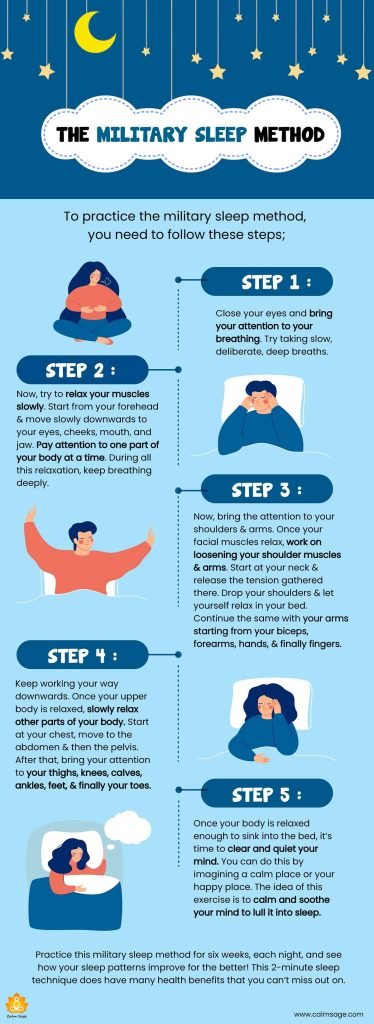
The entire process should take about 120 seconds. Don’t rush it; the slowness and deliberateness are part of the magic. Assume a comfortable sleeping position on your back, if possible, as this allows for optimal muscle relaxation.
Step 1: Relax Your Entire Face
Start with the window to your tension: your face. Close your eyes and bring your awareness to the complex network of 43 muscles in your face.
- Forehead & Brow: Smooth it out. Imagine your forehead is as flat and calm as a still pond. Let your eyebrows drift away from each other.
- Eyes: Feel the tension in the sockets and the eyelids. Let them go completely limp. Don’t squeeze them shut; just allow them to rest heavily in their sockets.
- Jaw & Cheeks: Let your jaw go slack so your lips part slightly. Don’t force a smile or a frown; aim for absolute neutrality. Feel your cheeks and the area around your nose soften and descend with gravity.
The goal is to make your face feel like a featureless, weightless mask.
Step 2: Drop Your Shoulders and Hands
Release the weight of the world from your shoulders.
- Shoulders: Inhale slightly, and as you exhale, let your shoulders drop as low as they can go, as if they are being pulled down by heavy weights. Feel the space between your shoulders and your ears widen.
- Arms & Hands: Start with your upper arms, letting them relax against the bed or pillow. Then move to your elbows, forearms, and finally, your hands and fingers. You can visualize a wave of relaxation flowing from your shoulders down to your fingertips. Some find it helpful to briefly tense their hands into fists and then release completely, noticing the contrast.
Step 3: Exhale and Relax Your Chest
Now, bring your attention to your core.
- Chest & Torso: Take a gentle, natural breath. As you exhale, feel your chest deflate and sink towards the mattress. Let go of any tightness across your ribcage. There should be no effort in your breathing. Allow your diaphragm to do the work.
- Back: Feel your entire back—upper, middle, and lower—spread out and melt into the surface beneath you. Release any tension you might be holding along your spine.
Step 4: Relax Your Legs
Move your focus down your body to your legs.
- Thighs: Feel the heavy weight of your thighs sinking down. Visualize the large quadriceps and hamstring muscles going soft and loose.
- Knees & Calves: Let your knees fall outwards naturally. Feel your calves become heavy and limp.
- Ankles & Feet: Finally, release all tension in your ankles and feet. Let your toes splay outwards. Imagine a final release of tension flowing out through the soles of your feet.
At this point, your entire body should feel like a sack of potatoes—heavy, limp, and completely supported by the bed.
Step 5: Clear Your Mind for 10 Seconds
This is the step most people find the most challenging, but it’s the crux of the method. For 10 seconds, you must stop thinking.
Your mind will rebel. It will want to jump to what you need to do tomorrow, a song you heard, or a problem you’re solving. The key is not to fight these thoughts, but to gently usher them out and focus on one of two mental images:
- Option A (The Static Image): Imagine yourself lying in a pitch-black, completely silent room, on a incredibly comfortable, soft, black velvet couch. There is nothing to see, hear, or do. Just stillness and darkness.
- ** Option B (The Dynamic Image):** Imagine yourself lying in a canoe on a calm, placid lake on a perfectly still day. Above you is a clear, deep blue sky. There are no ripples, no sounds. You are just drifting gently, staring up at the endless, empty blue.
If a thought intrudes, don’t get frustrated. Acknowledge it without judgment (“There’s a thought about my meeting”), and gently return your focus to the black velvet or the blue sky. The goal is to achieve a state of mental blankness for a full 10 seconds.
Step 6: The Mantra: “Don’t Think, Don’t Think, Don’t Think…”
If you find your mind is particularly resistant to Step 5, this final step acts as a cognitive override. For the next 10 seconds or so, repeat the phrase “don’t think” in your mind. Say it slowly, calmly, and rhythmically.
“Don’t… think… Don’t… think… Don’t… think…”
This simple, repetitive mantra occupies the phonological loop of your working memory—the part of your brain that holds verbal information. By filling this space with a non-stimulating, simple command, you effectively block out more complex, anxiety-provoking thoughts. It’s a mental placeholder that keeps your conscious mind busy with a boring task until sleep naturally takes over.
Read more: The “Soft Life” Revolution: Why American Women Are Prioritizing Ease and How You Can Too
The Psychology Behind the Power: Why It Works
The Military Method isn’t just a random collection of steps; it’s a brilliant application of established psychological principles.
- Progressive Muscle Relaxation (PMR): Steps 1-4 are a condensed form of PMR, a clinically proven technique for reducing anxiety and improving sleep. By systematically tensing and then relaxing muscle groups (or, in this case, just focusing on the relaxation), you become more aware of physical sensations of tension and release. This physical relaxation directly influences the psychological state, triggering the PNS.
- Cognitive Load Theory: Your brain’s “working memory” has a limited capacity. Steps 5 and 6 work by occupying this limited space with a simple, undemanding task (visualizing a calm scene or repeating a mantra). This leaves no cognitive resources available for worrying, planning, or problem-solving—the very activities that keep you awake.
- Classical Conditioning: With consistent practice, you are conditioning your body and mind. The specific sequence of actions—relaxing the face, dropping the shoulders, etc.—becomes a powerful cue for sleep. Over time, simply beginning the ritual signals to your entire system that it is time to shut down, making the process faster and more automatic.
Mastering the Method: Practical Tips for Success
Don’t be discouraged if you don’t succeed on the first night. The original military program allowed for six weeks of practice. Here’s how to set yourself up for success:
- Practice During the Day: First, try the method during the day while lying on the floor. Without the pressure of having to fall asleep, you can familiarize yourself with the sensations of deep relaxation.
- Create a Sleep-Conducive Environment: The method is powerful, but it’s not magic. Support it with good sleep hygiene. Ensure your room is dark, quiet, and cool. Invest in a comfortable mattress and pillows.
- Be Consistent: Practice the method every single night, even on weekends. Consistency reinforces the conditioning.
- Be Patient and Non-Judgmental: If your mind wanders, which it will, don’t berate yourself. The act of gently returning your focus to the relaxation or the mantra is the practice. Frustration is just another form of mental arousal that will keep you awake.
- Breathe Naturally: Don’t force any special breathing pattern. The goal is to let your breath find its own natural, slow rhythm as your body relaxes.
- Combine with Other Techniques: The Military Method can be beautifully complemented by other evidence-based practices. For example, you could practice the 4-7-8 breathing technique (inhale for 4, hold for 7, exhale for 8) for a few cycles before starting Step 1, to initially calm your nervous system.
Beyond the Barracks: Who Can Benefit?
While designed for soldiers, the applications of this method are universal.
- The Stressed Professional: For anyone whose mind races with deadlines and emails at bedtime.
- The Anxious Student: For those kept awake by exam pressure or social worries.
- The New Parent: To maximize the quality of short, unpredictable periods of sleep.
- The Frequent Traveler: To overcome jet lag and sleep in unfamiliar hotel rooms or noisy environments.
- The Chronic Insomniac: As a structured, drug-free tool to break the cycle of sleep-related anxiety (“Will I be able to fall asleep tonight?”).
A Final Word: Reclaiming Your Right to Rest
The Military Sleep Method is more than a trick; it’s a form of mental and physical discipline. It hands you the reins to your own nervous system, empowering you to consciously choose rest over reactivity. In our always-on, hyper-stimulating world, this ability is not just a convenience—it’s a cornerstone of health and well-being.
It won’t solve underlying medical sleep disorders like sleep apnea, and if you suspect you have one, please consult a doctor. But for the vast majority of us struggling with common sleeplessness, it offers a proven, free, and deeply effective path to the rest we desperately need.
So tonight, when the lights go out and the thoughts begin to swirl, remember the declassified secret. Relax your face. Drop your shoulders. Clear your mind. And surrender to the science of sleep.
Read more: Financial Self-Care: Budgeting and Mindset Shifts to Reduce Money Stress
Frequently Asked Questions (FAQ)
Q1: I’ve tried this for a few nights and it’s not working. What am I doing wrong?
You’re likely not doing anything “wrong.” The original training program took six weeks. The most common issues are:
- Trying too hard: The paradox of sleep is that you must let it happen, not force it. Approach the steps with an attitude of “I’m just going to relax deeply, and if sleep comes, that’s a bonus.”
- Skipping the practice: Practicing during the day is crucial for building the skill without performance pressure.
- Getting frustrated by mental chatter: Expect your mind to wander. The success of the method lies in the gentle return to the relaxation or mantra, not in achieving perfect, sustained silence.
Q2: Is sleeping on my back necessary? I’m a side/stomach sleeper.
While the original method was taught with soldiers on their backs, the core principles are adaptable. The key is to go through the systematic relaxation of all muscle groups from head to toe, regardless of your position. If you are a side sleeper, you can still relax your face, let your shoulders droop forward, relax your chest, and so on. The body scan is more important than the position.
Q3: How is this different from meditation or mindfulness?
There is significant overlap. Mindfulness meditation involves observing thoughts without judgment and returning to an anchor (like the breath). The Military Method is a more goal-oriented, direct protocol for sleep onset. It uses a specific physical relaxation sequence and a more active mental distraction/clearing technique. Think of mindfulness as a broad practice for daily life, and the Military Method as a targeted tool for a specific situation (falling asleep).
Q4: Can I use this method if I have a diagnosed sleep disorder like insomnia or sleep apnea?
This method can be a very helpful component of Cognitive Behavioral Therapy for Insomnia (CBT-I), which is the gold-standard treatment. However, if you have sleep apnea, a physiological disorder where breathing stops during sleep, this method will not address the root cause. It is essential to seek diagnosis and treatment from a sleep specialist for any underlying medical condition.
Q5: What if the “don’t think” mantra makes me more anxious?
This is a known phenomenon called “ironic process theory,” where trying to suppress a thought makes it more prominent. If repeating “don’t think” feels counterproductive, simply switch to a more neutral, monotonous mantra. You could try a single, meaningless word like “the…” or “one…” repeated slowly. Alternatively, double down on the visualization in Step 5. Immerse all your senses in the black velvet room or the calm canoe.
Q6: Can I use this for naps?
Absolutely. This is one of its greatest strengths. The method is designed to facilitate sleep at any time of day, in less-than-ideal conditions. It is perfect for a power nap to recharge your energy.
Q7: Are there any risks or downsides to this method?
There are no physical risks. The only potential “downside” is the initial frustration if you expect instant results. It requires patience and consistent practice. Some people may also find that focusing intently on their body makes them more aware of physical sensations, which can be distracting at first. This usually subsides with practice.
Q8: Where can I find the original source material?
The method was detailed in the 1981 book “Relax and Win: Championship Performance” by Lloyd “Bud” Winter. While the book is out of print, it can be found through used book sellers, and its concepts are widely cited in modern sleep and performance literature.